The short verdict: Ahrefs wins on backlink data depth and freshness, which makes its Domain Rating the sharper competitive yardstick, while Moz wins on price and approachability, and its Domain Authority remains the score most clients recognize.
Underneath sit two genuinely different metrics that people wrongly use interchangeably. Here is what each measures, with pricing verified from both vendors' pages this July.
| Moz | Ahrefs | |
|---|---|---|
| Authority metric | Domain Authority (DA), 0-100 | Domain Rating (DR), 0-100 |
| What it measures | Predicted ranking competitiveness | Backlink profile strength |
| Entry plan (monthly) | $49 Starter, single site | $29 Starter (limited), $129 Lite |
| Standard plan | $99/mo, or $79 on annual billing | $129/mo Lite, annual saves up to 17% |
| Mid tier | $179/mo Medium ($143 annual) | $249/mo Standard |
| Tracked keywords (standard) | 300 per month | 750 |
| Free option | Link Explorer free with account | Free checkers + own-site tier |
| Known for | DA, beginner-friendly UX | Crawler scale, fresh link data |
DA and DR are answering different questions
This is the part most comparisons skip. The two scores are not rival attempts at the same number.
Practical consequence: judge a link-building target by DR, judge "can we compete with this site at all" by DA, and always compare rivals within one tool, never across tools.
The Ahrefs case
Ahrefs runs one of the most active crawlers on the web, and its backlink index updates fast. When a competitor gains or loses links, DR-side data shows it sooner than most rivals.
For competitor analysis specifically, that freshness matters more than any score formula. Link velocity, new referring domains and lost links are the signals that show a rival's momentum.
The 2026 pricing on monthly billing: Lite at $129 with 750 tracked keywords and 5 projects, Standard at $249, Advanced at $449, plus a stripped $29 Starter. Annual billing saves up to 17 percent.
The Moz case
Moz invented the authority-score genre, and Domain Authority is still the number clients and journalists quote. If you report to people outside SEO, DA is the score they already believe in.
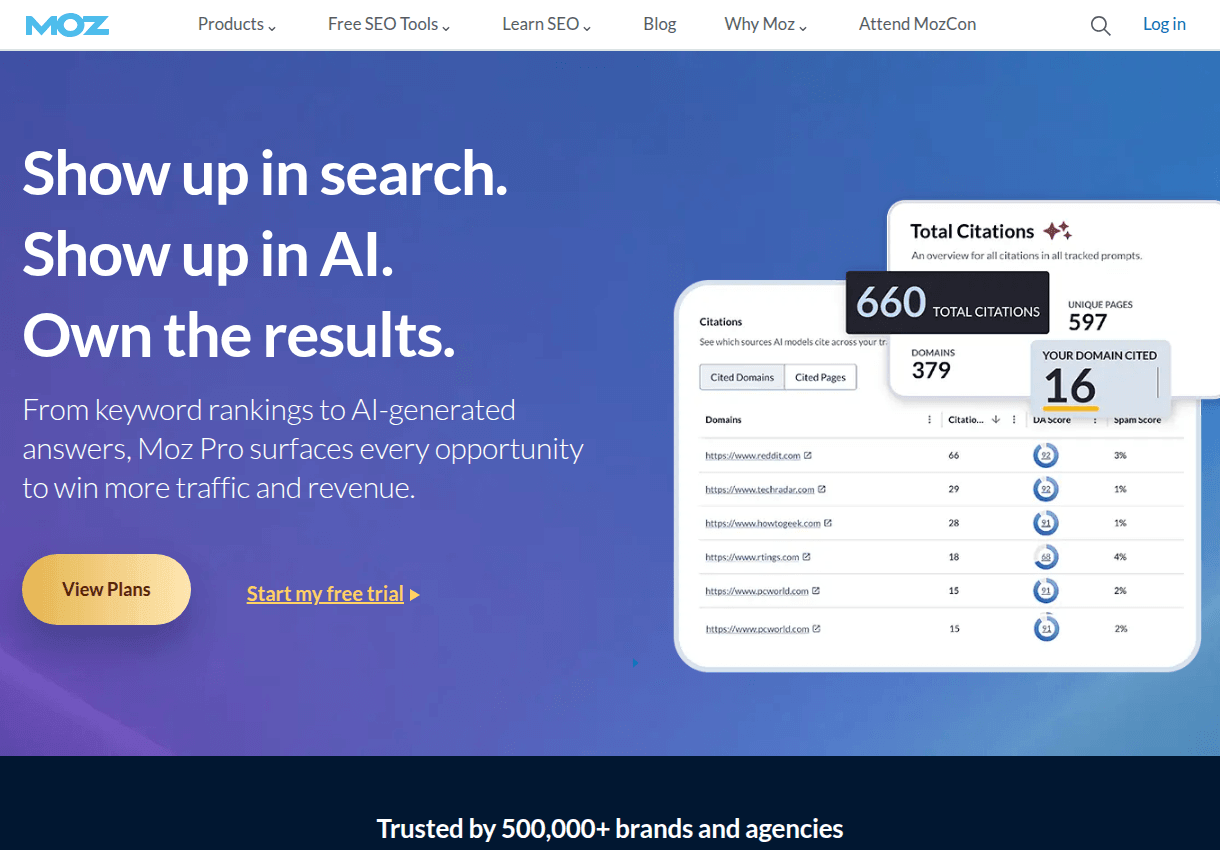
It is also simply cheaper to start. The 2026 pricing: a $49 single-site Starter, Standard at $99 a month ($79 on annual billing) with 3 tracked sites and 300 keywords, Medium at $179 ($143 annual), Large at $299 ($239 annual).
DA's redesign made it harder to game than the old version, and Moz's Link Explorer shows it free with an account. The index is smaller than Ahrefs' and updates more slowly, which is the honest trade for the price.
Choose Ahrefs if...
- Backlink analysis is the core job, because index size and freshness beat any score formula.
- You track competitor link momentum, not just a snapshot number.
- You will actually use the bigger toolkit: content gaps, broken link recovery, top pages.
Choose Moz if...
- Budget decides it: $49 in, and $99 for the full standard toolkit, is roughly half of Ahrefs Lite.
- You report DA to clients or executives who already know the metric.
- You want the gentler learning curve for a small team.
Using authority scores without fooling yourself
Whichever tool you pick, the same three rules keep the scores honest.
First, scores are relative. A DA of 35 means nothing alone and everything next to your rival's 28.
Second, scores are estimates from sampled link data, like the traffic estimates we covered earlier. Direction over months beats any single reading.
Third, authority is one lens. A low-authority site with exactly the right pages outranks a high-authority generalist constantly, so pair the score with a look at what actually ranks.
How we compared them
Pricing and plan limits were pulled from both vendors' public pricing pages in July 2026. Neither company sponsors this site and there are no affiliate links here.
The one-line takeaway: Ahrefs and DR for serious backlink work and competitor momentum, Moz and DA for budgets, beginners and client reporting. Both scores are estimates: compare within one tool and watch the trend, not the number.