Every keyword a competitor ranks for and you do not is a pre-validated opportunity: proof that sites like yours can win that query. A gap analysis finds all of them in one run, free.
Here is the full method: pick the right rivals, run the comparison, and triage the output into an actual plan instead of a 2,000-row spreadsheet you never open again.
What a gap analysis actually shows
Comparing two sites' rankings splits every keyword into three buckets, and each bucket has its own job.
"Only you" keywords are your moat: check they still get traffic, then defend them. "Both" keywords are battlegrounds where position decides the traffic split.
"Only them" is the gap, and the rest of this article is about mining it.
Step 1: pick true search competitors
Your business competitor and your search competitor are often different sites. The gap analysis only works against sites that actually compete with you in Google.
The test: search five of your most important keywords and note who keeps appearing. A niche blog, a directory or a software rival you never think about may own your SERPs.
Pick the two or three that appear most and are roughly your size. Gap-analyzing Wikipedia teaches you nothing you can act on, and our authority metrics guide covers how to judge "roughly your size" quickly.
Step 2: run the gap tool
The Keyword Gap Analysis tool from the Keywords Everywhere team runs the comparison free: your domain, up to two competitors, one click.
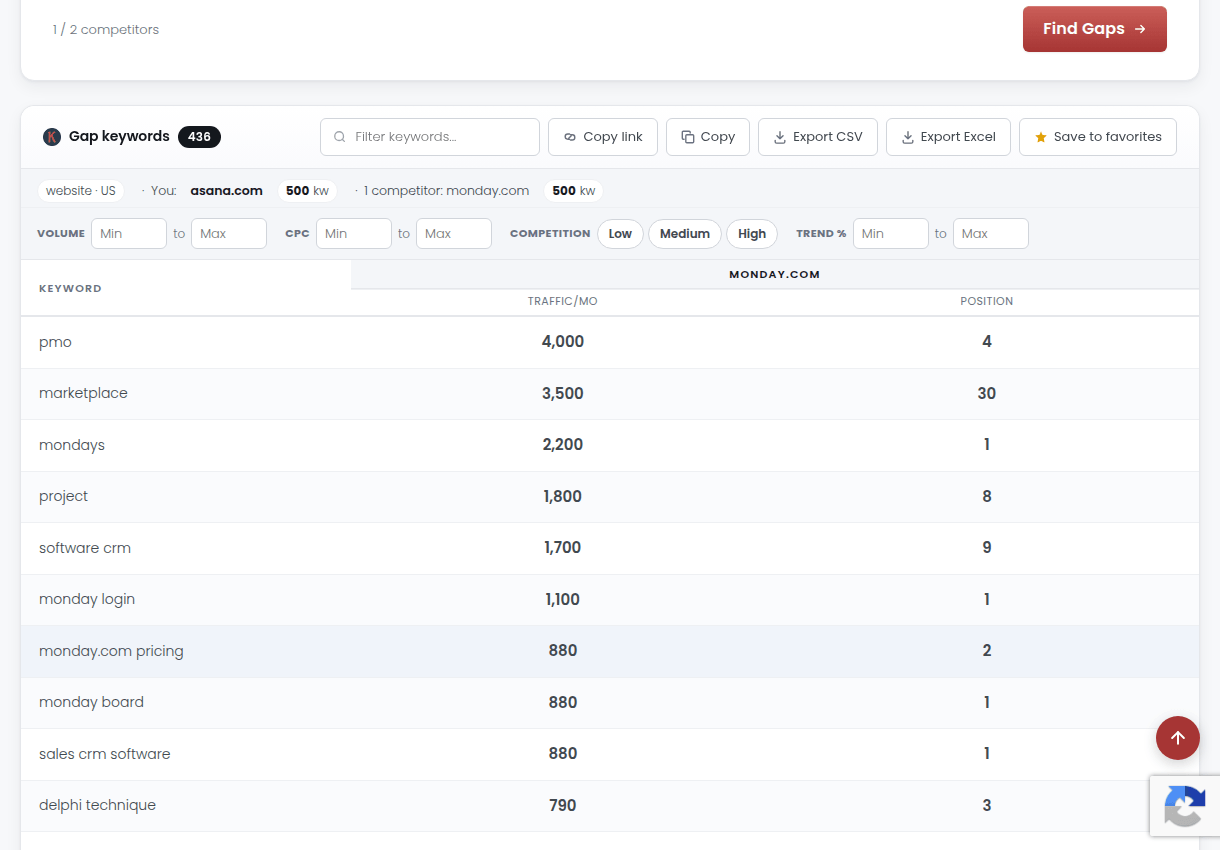
The output is the rival-only keyword list, with each keyword's monthly traffic and the position they hold. Export it, because the raw list is the input to the real work, not the result.
The paid suites run the same report with bigger limits if you outgrow the free run: Semrush's Keyword Gap and Ahrefs' competitive analysis both compare more domains at once.
Step 3: triage the list
A raw gap list is mostly noise: brand terms, irrelevant queries, keywords too big to win. Triage cuts it to the rows worth acting on.
| Cut | Remove | Why |
|---|---|---|
| Brand cut | Their brand name and product names | You will never rank for "monday.com pricing", and should not try |
| Relevance cut | Keywords off your topic | Big sites rank for accidental queries constantly |
| Reality cut | Head terms far above your authority | Save them for later, win the middle first |
| Intent cut | Queries your content cannot serve | A tool site should not chase recipe-style queries |
What survives is usually 10 to 20 percent of the raw list. That remainder is dense with real opportunities.
Step 4: sort survivors into two piles
The improve pile pays out fastest. Adding a missing section to a page that already has some authority routinely moves it from nowhere to page one.
The create pile becomes your content calendar, ordered by volume times relevance. Two or three gap-closing pages a month compounds quickly.
Step 5: steal the format, not the words
For each keyword you decide to chase, look at the rival page that ranks. Note its format: listicle, comparison table, calculator, long guide.
The format is part of why it ranks. Match it, then beat the substance: more specific numbers, fresher data, better examples. Never copy the content itself, both for ethics and because duplicates lose.
Reading the gap strategically
Beyond individual keywords, the shape of the gap tells you the rival's strategy. Clusters of gap keywords are entire topics they bet on and you skipped.
If a competitor suddenly ranks for fifty new keywords in one topic, they are investing there right now. Pair that signal with their traffic trend and you are reading their roadmap in public data.
The one-line takeaway: run a free gap analysis against two true search competitors, triage hard, then split survivors into pages to improve and pages to create. It is the highest-yield hour in competitor research.